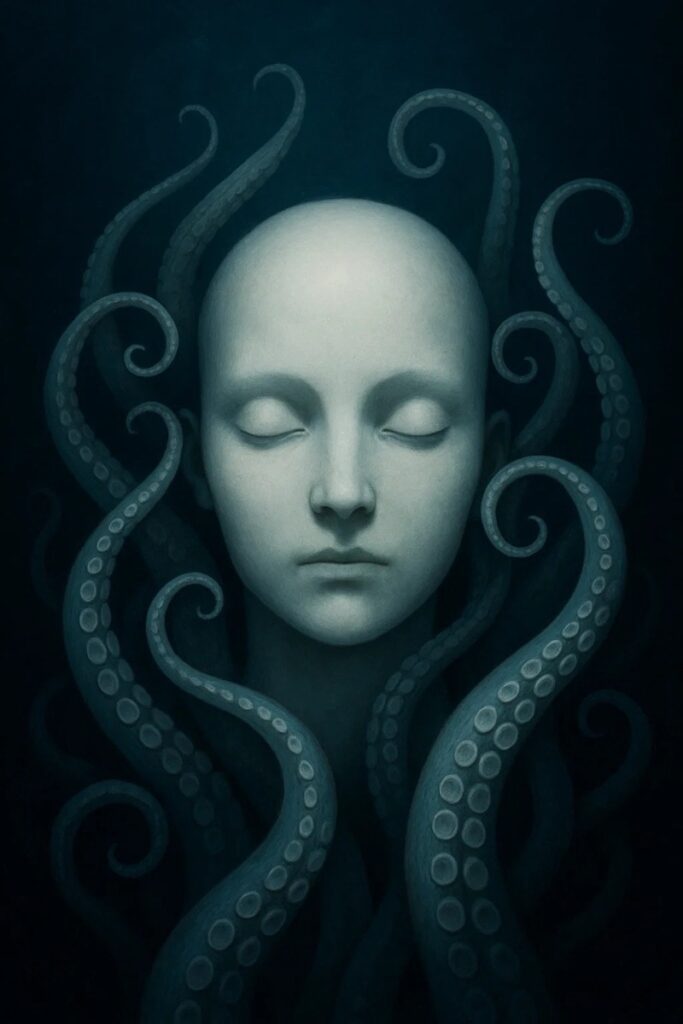
At first, the tentacles are small.
Harmless, wispy little things.
A little curl around the wrist when you wake and reach for the glowing rectangle on the bedside table before your eyes are fully open. A soft coil around the throat when the silence lasts too long without music, without voices, without something—anything—pouring into you.
You barely notice them.
No one does.
They arrive slowly, politely. They do not seize. They suggest. They tickle. They tantalise, or tease.
“Just one.”
“Just for a couple of minutes.”
“Why not another, it doesn’t hurt anyone, right?”
Another scroll.
Another drink.
Another level.
Another episode.
Another little pulse of warmth in the dark folds of the brain.
Reward.
The tentacles cling and thicken when rewarded.
Not painfully.
Pleasantly.
That’s the trick of it.
People think addiction arrives screaming, wild-eyed and desperate. They imagine needles, powders, ruined lives in alleyways.
But most tentacles arrive dressed as comfort.
As routine.
As relief.
The man at the bus stop checks his phone fourteen times in three minutes, not because anything matters, but because maybe, hopefully, something might. A message. A like. A flicker of acknowledgment. The possibility itself is enough to feel the soft exploratory touch curling around the inside of his skull.
The woman lying awake at two in the morning watches one more video, then another, then another. Her eyes ache. Her breathing is shallow. The algorithm strokes her gently behind the eyes, rewarding her endurance with tiny biochemical pellets like feed dropped into a tank.
She does not notice the tentacles winding deeper while she watches strangers organise kitchen cupboards and discuss celebrity divorces.
Perhaps she notices.
Perhaps she just doesn’t stop.
The coils learn.
That is the worst part.
They study the gaps in you.
Loneliness.
Fear.
Boredom.
Want.
The old unhealed wound that aches when the room becomes too quiet.
The tentacles slip carefully into those spaces. Fill them. Hide them.
Not to heal.
To anchor.
And once anchored, they begin to pull.
Not all at once.
Just enough.
Just enough that silence becomes unbearable.
Just enough that stillness feels like suffocation.
Just enough that every unoccupied second sends the psyche scratching desperately for stimulation like a tongue probing a broken tooth.
The old pleasures weaken first.
Sunlight through trees.
The taste of coffee.
A slow conversation without interruption.
The texture of rain against a window.
These things are small. Quiet.
The tentacles dislike quiet.
Quiet threatens hunger.
So they tighten whenever silence approaches.
A notification vibrates.
A tab opens.
A hand reaches automatically.
A mind fragments willingly.
Reward.
Reward.
Reward.
The loops deepen.
People speak now of “dopamine fasting,” as though abstinence were enough, as though the tentacles politely loosen when denied for a few hours. But deprivation only makes them attentive. Hungry. Coiled tighter in anticipation.
Waiting.
The modern world breeds excellent tentacles.
Efficient ones.
Algorithmic tentacles with analytics departments and engagement metrics their creators themselves have given up the hope of understanding.
Tentacles refining themselves by constant market testing.
Once, parasites had to evolve naturally. Now they receive venture capital, and take on a life of their own.
And the beautiful thing—the truly beautiful thing—is that the hosts defend them.
Watch someone lose signal for thirty seconds.
Watch the agitation bloom.
Watch the fingers twitch.
Watch the eyes search instinctively for the next feed, the next pulse, the next chemical absolution from the horror of uninterrupted thought.
The tentacles do not force this.
They merely offer relief.
Again.
Again.
Again.
Until eventually the person no longer reaches for stimulation.
The stimulation reaches through them.
By then the tentacles are no longer wrapped around the psyche.
They are threaded through it.
And somewhere deep inside, beneath the endless seeking and scrolling and consuming, something soft and human sits very still, dimly remembering what it once felt like to want nothing at all.
Do you remember yourself?
Do I?