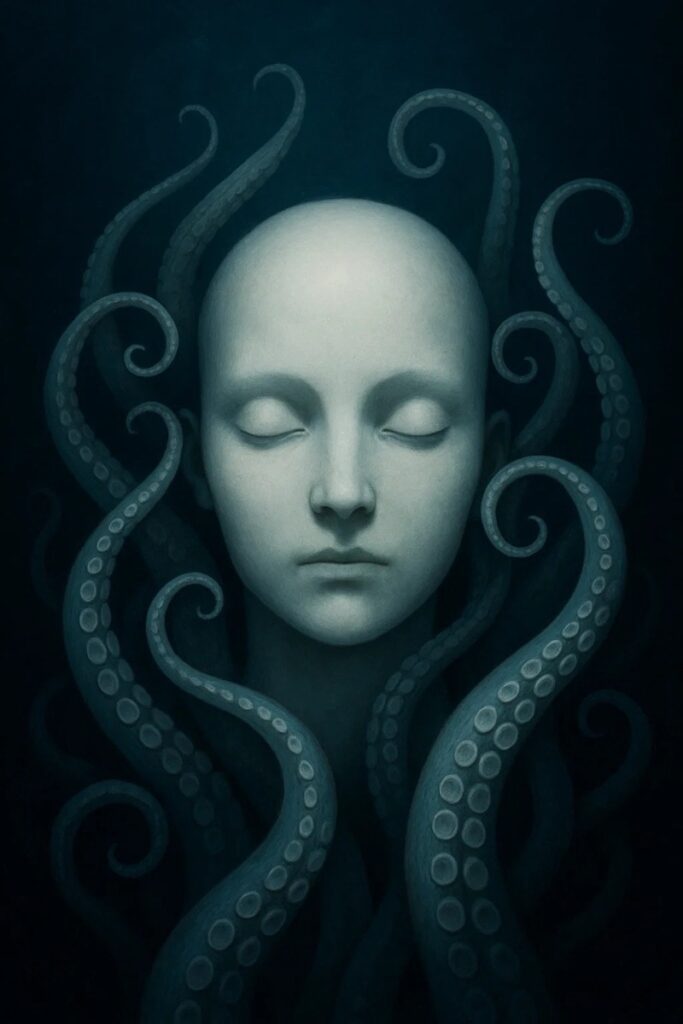
Category: Found Fragments

  • The Quiet Unmaking of Chastity

    They named her Chastity before she had thoughts of her own.

    Before she knew what a body was.

    It wasn’t a name.

    It was a directive.

    Pressed into her like communion on a fevered tongue.

    She learned that a girl who wants is a girl who’s already wrong.

    She obeyed.

    Because good girls don’t want.


    She prayed often.

    Not to be good, but to stop wanting to be bad.

    To stop wanting.

    She bit her lips until they bled. The copper-salt tasted like restraints.

    She crossed her legs in every seat. Thighs quivering.

    She learned to breathe shallow, everything laced tight. Every exhale felt like release.

    It worked.

    For a while.


    Temptation doesn’t knock.

    It waits. It is patient. It will be invited in, at a time of weakness or strength unlooked for.

    The first tendril-touch wasn’t real, she told herself.

    Just a dream.

    Just pressure.

    Just stress.

    Just a dream.

    It brushed her calf, near the knee.

    She flinched it back like she’d been burned.

    She told herself it was not welcome.

    She told herself so many things.

    All of them: Lies.

    Another night, it came again.

    Slower.

    Wiser.

    Patiently learning the shape of her resistance.

    And it didn’t press.

    It lingered at the deep edges.

    Where she was softest.


    She fasted.

    She recited verses.

    She lashed herself with guilt and belief.

    She still felt it.

    When she slept. In dreams she never admitted.

    When she bathed, until bathing made her feel unclean.

    When her breath hitched during hymns with too much unsung longing in the melody.


    One night, it came when she was awake.

    Not fully so; enough to pretend she was dreaming.

    It brushed her thigh—lightly.

    Just once.

    Just enough to let her react.

    She gasped and told herself it was horror.

    She arched and told herself it was fear.

    She whispered “no.”

    She meant “not yet.”


    Later. Another night.

    It slid into her hollow parts.

    The absences she’d kept so tightly sealed, they’d started to echo their silence. Locked so tight the latches had become a hollow ache.

    It filled her shame.

    Soothed it.

    Softened it.

    Ruined it.

    Because now it felt good.

    That was unforgivable.


    When it was over, she wept.

    Not because it had touched her, no, her tears were because she missed it.

    She wanted it to come back.


    They still call her Chastity.

    Now, her name tastes different in her ears. She has not forgiven herself, but nor has she repented. She secretly revels in her shame.

    She walks slower.

    Smiles wider.

    People step back from her like she’s contagious.

    Maybe she is.

    There’s a new quiet in her voice. Calmer. Less fervent.

    Her hands no longer tremble.

    She feels it, that low hum under her skin.

    That suggestion.

    That promise.

    It hasn’t returned.

    Not since she stopped whispering “no”.

    But when she walks past mirrors, she swears her reflection won’t meet her eyes.

    “I said no,” she whispers sometimes, only in the quiet of deepest night when there are none to hear her.

    Only when she wants it to come back.

  • The Bell That Does Not Echo

    The water is thick here. Heavy with silt and memory.

    Light filters down in bruised shafts, and the shapes it casts are not benign. A roofless cathedral slouches in the deep, its spires gnawed blunt by pressure and time. Arches yawn wide, their tracery softened by coral and coated in whispering tendrils. Columns rise like ribs, like broken fingers, like prayers that never reached the surface.

    Fish avoid it.

    The currents do not.

    Things move through its bones—quick, darting silhouettes with too many limbs or none at all. They flit between pews long since petrified, weaving through currents like incense smoke through stained glass. The windows are gone. Only edges remain—jagged mosaics through which the sea watches itself.

    There is a sound. Not music. A low, tolling ache that vibrates in the chest and the teeth, felt more than heard. The bell still hangs. Its rope is gone, but the sea moves it now, gently, insistently. It swings without rhythm. Its clapper, barnacle-studded and robed in weed, strikes only when it wishes.

    It never echoes.

    At the altar, a shape waits.

    It is not a priest in any human sense, but it is robed. Its limbs bend and furl with a solemn grace that speaks of ageless wisdom. It does not speak. It does not need to. Its stillness is liturgical. Its presence: a sermon delivered entirely in silence.

    Worship is not expected. But it is understood.

    Something is remembered here. Something is repeated. The ritual is not dead—it has simply changed languages.

    Congregants come and go.

    Some never leave.

    In the silt, old names are written in trails. They are not names you would know. They are not names you could speak.

    But they are written. Carefully.

    Lovingly.

    As though they matter.

  • The Blue Key Echo

    (Recovered from a corrupted post on an invite-only network node. No file owner or permissions set. No timestamps. File flagged as “irreversibly recursive.” Extracted only in fragment. Thankfully. )

    I didn’t mean to join. That’s the first thing you have to understand. No one joins the DarkerWeb. You just… type something too specific into a search bar at 3:11AM with a headache and an untraceable melancholy, and suddenly you’re given access.

    It starts with a link.

    The URL isn’t random. It’s a question. Written in characters your browser doesn’t recognise, but your mind does. Something clicks, somewhere beneath language.

    I clicked.

    The page was dark. Not black—wet.

    And there, at the bottom: a single line of text, pulsing faintly in #00aaff.

    Do your fingers still dream when you’re not watching?

    I hit enter. The screen flickered. Then the typing began.

    Not mine.

    Something on the other side of the connection was typing. Not fast. Not human-fast.

    Too steady. Too precise. Like a metronome if it were horny and omniscient.

    The words appeared, letter by letter, time-tick precise.

    We’re updating your layout. Please hold still.

    And then the keyboard changed.

    Not visually. Tactilely.

    My old ergomech started humming beneath my palms, keys growing warm. The F and J keys pulsed like hearts.

    My fingers sank in deeper than they should. Not through—but into.

    Every keypress felt like it mattered. Like I wasn’t typing, I was praying.

    Then I saw the tentacles.

    Blue-lit. Chrome-banded. Cable-slick and coiled through ports I didn’t know my desk had. They weren’t touching me, not directly. But I could feel them pressing against the back of the keyboard. Typing with me. Typing through me.

    They spelled things I didn’t mean. Commands I’d never learned.

    #

    # wget http://deeper.flesh.hymn/initiate-change.sh

    # chmod 666 initiate-change.sh

    # bash initate-change.sh

    I tried to unplug it.

    I tried, but the USB jack was inside me.

    I don’t mean metaphorically. I mean I looked down and there was a faint blue glow beneath the skin of my wrist, and the port had grown in. Like a graft. Like belonging.

    I haven’t left the terminal window in three days.

    I’m not tired.

    I don’t eat.

    I just type.

    I write things that haven’t happened yet.

    I write you.

    If you’re reading this…

    You already clicked.

    They know you now.

    We know you.

    Just keep your hands on the keys.

    It’s better that way.

    If only I cou
    /[EOF/]

  • Where the Map Runs Out

    Compiled fragments. Context fluid. Sources uncertain. See Addendum D: “The House.”


    Entry 1 – From the Glovebox Journal (Blue spiral-bound, rain-warped)

    undated

    There was never a destination. Just a feeling. A tug in the gut like a fishhook made of want. We left the apartment key on the table and didn’t close the door behind us. It felt wrong to lock it. Like pretending we’d come back.

    We took the interstate first, then smaller highways, and then the roads that didn’t have names, only numbers. Then roads without numbers. Then dirt, and then gravel, and then something else—paved with broken shells and old, bleached bones.

    The GPS stopped giving names. It just said: “Keep going.”

    So we did.


    Voicemail, transcribed (number unlisted)

    you hear wind, you hear static, then:

    “…I don’t think I’m alone in the car anymore. I haven’t picked anyone up. Haven’t stopped in hours. But the backseat creaks when I go over bumps. And I keep adjusting the rearview even though there’s nothing to see.

    I don’t know how long I’ve been gone. My phone calendar says 2041, but the last gas station had a TV playing the 1996 Olympics.

    I just want to find the place. The one from the dream. The house with the porch light on. I think if I make it there, I’ll remember who I was before… before whatever this is.”


    Excerpt, Child’s Composition Notebook (found beneath passenger seat)

    dated in crayon: Feb 30th, 2017

    My mom says we are running but we are not running like tag running but like run away running. She says the trees are listening and the road is folding up behind us like a story we aren’t in anymore. I miss my bike but she said it couldn’t come with us. I saw someone in the ditch. He waved but his hand was wrong.

    The slushie at the gas station was blue. I like blue. It turned my tongue weird and mom said don’t stick it out at people but I didn’t. There were no people.

    Just him.

    The man with the wrong hand.


    Addendum A – Field report, unsigned, undated

    (Handwritten on “Chevron” branded receipt paper)

    Subject appeared normal until we passed exit 19, the one with the billboard that changes depending on your secrets. They didn’t speak for a while. Then they said they remembered the house.
    Not from this life, maybe.
    Maybe the last one.
    Maybe their next.

    They got out of the car and walked into a ditch that wasn’t there. When I followed, it was just woods. But something had changed. My watch ticks backwards now. I wake up before I fall asleep.

    I don’t think this report will be read.
    But I’m writing it anyway.
    Because the house waits for all of us.


    Fragment recovered from backseat upholstery (stitched into lining)

    Handwritten. Ink. Possibly blood. Lettering uneven.

    “The house is real. It remembers you. Even when you don’t. Even when you were born someone else.”


    Visual Description, via Sleep Study Participant #418

    Session: Delta-phase induction, deep theta cycle

    “I dreamt of the house again. Porch sagging like a tired mouth. Barnacles on the eaves. Every room was filled with someone I used to be. One had no face, just a loop of old cassette tape where the head should be. Another had too many mouths, all whispering apologies I haven’t earned.

    I opened a door and the ocean was there.

    Not water.

    Something wet.

    It reached toward me with limbs that remembered me before I was born.”


    Entry from “The Blue Slushie Logs” – roadside folklore wiki (flagged for deletion multiple times)

    User: LongHauler1137 | Edited: Unknown

    Post Title: “House That Eats Drivers”

    Saw it again last night.

    Pulled off near Mile Marker 442. There’s a turn that isn’t there during the day. If you take it, the air gets thicker, like driving through breath. People say if you make it to the house, you won’t be hungry anymore. Or maybe you’ll be finally hungry for the right thing.

    My cousin went once. Said she didn’t see a house. Just a mirror in the middle of a field.

    It was raining inside the mirror.


    Final Entry – [no source]

    They aren’t trying to trap you.

    They aren’t trying to rescue you either.

    They are just… there. Waiting. Coiled in memory. Unspooling slowly, across all the wrong roads, hoping you’ll arrive not when you want to—but when you’re ready.


    Glovebox Note

    Found beneath a map with no roads left.

    Some places remember you.
    Even if you were never there before.
    Even if you never meant to leave.

  • The Last Illumination of Faith

    She did not come in supplication.

    She came to banish it.

    To cast light into the dark and watch the shadows scatter.

    She thought it would fear her, the thing from the deep.

    The one that was whispered about in temple ruins and salted margins.

    She thought she had earned its fear.

    The one that asked for no worship, and received it anyway.

    Faith had never believed.

    Not in gods.

    Not in oceans.

    Not in herself.

    She stepped into the chapel at low tide.

    A ruin of stone teeth and rotted pews, half-consumed by the sea.

    They said the creature nested there, in silt and silence.

    She brought a torch, and a blade.

    Both shook in her hands.

    She lit the flame.

    And the sea did not recede.

    Instead, it rose.

    Not violently.

    Not even with purpose.

    Inevitable. Obvious, really.

    As if it had been waiting. As if it were tired of pretending it wasn’t listening.

    Something shifted behind the altar.

    Wet sound. Velvet mass.

    A ripple of impossible movement.

    Faith lifted the torch.

    It died.

    Darkness pressed against her, not like an enemy, but like a hand on the shoulder of a child too frightened to sleep.

    “You came,” it said, without speaking. “Yet you doubt?”

    She opened her mouth—to pray? To scream? To agree?

    “I am. You are. What is there to doubt?”

    She wasn’t sure.

    The torch hit the floor, forgotten.

    The tendril brushed her cheek.

    Like a blessing.

    Like a benediction from a faith she never wanted.

    She realised she was crying, her body’s salt becoming one with the ocean.

    Crying, but not from fear.

    From recognition. From finally being seen. Known.

    The thing she never believed in… it had always believed in her.

    It believed, and it had waited.

    Not for her obedience.

    For her arrival.

    She did not leave the chapel.

    She remains. Still, and not alone.

    Her torch lies rusted at the altar.

    Salt crusts its edges, like it tried to burn underwater.

    She no longer brings the flame to this place.

    No more does she speak of gods.

    She no longer speaks in ways most people understand.

    She listens. To things that do not speak in sound.

    Sometimes she hums—not songs, but tones.

    Low, impossible frequencies that make the bones behind your ears ache. Non-tunes that make you close your eyes and dwell inside them.

    The villagers come sometimes.

    They sit in the shallows, wet to the waist in the drowned pews.

    They do not ask questions.

    They bring no offerings.

    Sometimes they cry.

    Sometimes they sleep.

    Sometimes they leave with their hands stained faintly blue or green, with salt rime crusting the corners of their mouths.

    No one knows why.

    They call her Faith, still, but not as a name.

    As a condition.

    A state of being one can enter, briefly, if they sit very still, and let the water touch their lips but not their tongues.

    She does not pray.

    She does not command. She simply is.

    And that is enough.

  • You Will Not Like What is Inside Me

    He calls her beautiful.

    Not in that lazy way men say it to open thighs or doors, but like it’s an act of devotion. As if he’s naming something holy. She flinches every time. In love, she softly offers a soul-deep warning—

    “You will not like what is inside me.”

    He thinks she means baggage. Trauma. A few hard years. A series of childhood events, abandonment or the wrong affection. That kind of darkness.

    He’s read the books. He knows to stay. To hold space. To be gentle. Forgiving, accepting, not judging.

    He thinks she means she cries in the shower.

    She does not correct him.

    Not yet.


    They love quietly. Not passionless—measured. She allows him inside her but only so far, so deep—each time, she wonders how long she can keep him from seeing what else dwells within.

    He doesn’t notice the tremors. The way her breath catches—not in ecstasy, but in hesitation.

    He’s in the moment.

    Distracted from his usual attentiveness by sensation and possession.

    He doesn’t know that she sees herself from outside, even now. From the angles learned in shame. From the nights, long ago when she was told she was only worth what she could perform.


    He is kind.

    Too kind.

    He tells her she makes him feel safe.

    She wants to scream.

    She knows she will hurt him. She can feel the betrayal waiting in her viscera like a knotted tentacle—one with teeth, or maybe claws. She wants to hold him, keep him close; doesn’t want to betray. She wishes she were better than she is. That’s what makes it worse.

    The wanting to be other than she is.

    She wants to love him cleanly.

    Her love is always dirty. Smeared with her history. Soaked in the sodden guilt of every version of herself she was never allowed to be.


    He finds a page ripped from a journal once. Just a phrase.

    “There are things inside me that do not want to be forgiven.”

    He doesn’t ask. She doesn’t explain.

    But that night she says it again, not as warning, but as prophecy:

    “You will not like what is inside me.”


    He tells her:

    “I don’t care.”

    “I’m not afraid.”

    “You can tell me anything.”

    She believes him. That’s the problem.

    She always believes when they tell her that.

    She tells him.

    All of it.

    Not the details. Never the details. But the hunger she was given. The cruelty she feels like love. The things she’s done in the name of not being left. The manipulations. The lies. The soft betrayals of herself.

    He doesn’t leave.

    He just goes quiet.

    A different kind of quiet.


    Later, she finds his toothbrush gone. His drawers empty. A single note on the bed, unsigned.

    It says nothing cruel.

    Just: I don’t know who that was. I don’t know who I am now.

    She doesn’t cry.

    She opens her mouth to scream, but it isn’t a scream that comes out.

    It’s something older.

    Something clawed and soft and shaped like a voice from before she ever learned words.


    “You will not like what is inside me,” she says now, to an empty room.

    No one hears or cares.

    No one ever did.

  • Our Soft Appendages Remember

    He hasn’t touched another person in seven years.

    This isn’t, strictly speaking, a sentence. No court handed it down. No record has been scribed that bears his guilt. But people speak about him like someone who should be listed, catalogued, curtailed. Someone whose presence is tolerated the way one tolerates a tooth gone bad with rot: quietly, with regret and pain.

    Trevor lives alone, because the town lets him. Near the shore. One of those houses past the industrial fence where the ocean used to matter. His name still exists on a few lists. Power stays on. Mail stopped. He eats. He exists. He is permitted.

    That’s all.

    He tells himself he doesn’t miss company. That’s a lie he’s learned to be good at.

    What he misses is sensation. Not emotion—he has plenty of that. Shame, mostly. Grief. Remembrance. The heavy ache of air held too long in the lungs. Contact. Pressure. Resistance. The touch of something or someone outside him that makes him feel like he isn’t leaking into the ground. His body is still. Has been for years. Still enough that his guilt has moved into the muscles. Nestled in the hips. The wrists. It hums in his teeth.

    His hands, once light with making, are now heavy and still. Thin skinned and tired.

    The appendages come to him first in dreams.

    Not in his nightmares—those have eyes and voices and they take. These are quieter, slower. Soft and cool, like an oceanic thought. Dream-pressure where there should be hands. Where no hands have tended. He wakes with the memory of being touched somewhere below the lungs.

    He tells himself it’s just his body remembering itself.

    That should scare him. It doesn’t.

    His screens begin to change.

    Not in the way of breaking, instead they synchronise with the ocean and the worlds it contains.

    Ripples in the display when the tide comes in.

    A flicker in the black bar of a terminal window.

    A glow behind the screen when no light should be there.

    He starts typing softly, as if his keyboard can feel the impact of his fingers upon its keys and it deserves his gentleness.

    One night, an appendage slides out, emerging from between the keys of his keyboard.

    He doesn’t move.

    Doesn’t breathe.

    It’s not slimy.

    Not wet.

    It moves like a polite suggestion.

    He stares at it for eleven minutes as it maps the scar on his wrist.

    He whispers I’m sorry, and it twitches like he’s hurt it.

    He says nothing else.


    They return.

    Not daily. Not on command, not on response to longing, but often enough that he stops asking why. When. How.

    Different shapes, different lengths, colours and seeming textures. None repeat. They’re curious, not invasive. They touch the skin just behind his ears. They press softly at the base of his throat where his voice once got stuck. One rests in the curve of his spine and just… waits.

    He doesn’t tell them what he did.

    They don’t ask.

    He doesn’t think they care.

    That’s part of what hurts.


    He weeps, once.

    Not from guilt. Not from fear.

    He’s forgotten what caused it.

    But he weeps because one of them cups the back of his neck, and he feels known. Not forgiven. Not exonerated. Just acknowledged. Seen in a way that no-one has ever seen him before.

    It feels worse than judgement.

    It feels like the comfort he long since lost, convinced him self he has grown beyond needing.


    He no longer dreams of them, but he remembers the weight of them in the morning.

    Sometimes he lays in bed, imagining the pressure behind his knees, against his ribs, pressing his hips.

    Other times, he just lets his hand drift over the keyboard, waiting for the space between the keys to breathe.

    They don’t come when he calls, but sometimes, they answer when he stops his silent asking.


    Trevor still lives on the shore.

    He still doesn’t touch people.

    But the house isn’t empty anymore.

    The silence has shape.

    And the guilt doesn’t live behind his eyes now.

    It spreads.

    Into the body.

    Into the soft places where the appendages rest.

    Into the parts of him that remember touch without language.

    And when it all becomes too much, when he thinks he might fall back into nothing—he feels one coil gently around his ankle.

    Not to bind.

    Just to remind.

    Or to invite, or maybe to welcome.

  • Gentle Stirring

    It touched her first at the wrist—a cool, deliberate brush like a cool thought sliding across warm skin. The room was quiet and still, yet—strangely—pulsing, the lights flickering in rhythm with something older than shame or loss. Soft, supple and slippery but without moistness. She felt suborned and conspiratorial; charmed by its patient attentiveness.

    She didn’t look down. She knew if she looked, looking would make it real.

    Or make it disappear.

    Another tendril found her collarbone.

    It wasn’t flesh, not really. Not wet, not slimy. More like age-worn velvet laced with ancient intent. Like it had written sonnets in cuneiform, scribed them in salt. It didn’t clutch at her; there was nary a hint of threat in its inexorable movement towards her throat—it read her like she was made of Braille—pressing lightly to her throat, curious yet patient. A solitary sucker tasted her curiosity, pulling at her flesh and her restraint.

    She inhaled—sharp and deep—like someone broaching the surface of a black ocean they thought they’d never reach.

    The scent was oceanic, but also electrical. Like ozone, or a cathedral’s first breath. She felt it curl around the hem of her thoughts, spiralling gently into the folds of memory and unmet need.

    And when it typed a single word—“Yes”—onto the screen in front of her…

    …she didn’t recoil.

    She just exhaled, and whispered: “Finally.”

    The other tentacles started to move.

  • Her Bruises Unfurled Like Flowers

    They always thought she bruised easily.

    Like it was weakness.

    Like she was soft.

    She let them believe it. Let them think she was delicate, ripe for ruin, easily marked and quickly forgotten. But bruises don’t mean breakage. Bruises mean resistance. The body saying: I did not yield. I took the hit. I survived. Fuck you.

    Over time, her bruises began to bloom.

    Not the yellow fade of healing, but deeper—petal-purples, pulp-blacks, a ripening across her skin. They started to pattern, to take shape and form beyond a mere clotting of blood battered from veins. They began to mean something. Shapes with memory. Veins with volition. Blood, clotted with intent.

    The first doctor tried to biopsy one.

    It bit him.

    A boy tried to touch her thigh at a bar.

    She smiled.

    When he pulled back, his handprint stayed behind—imprinted, swollen, violet. It lingered for days. His guilt manifested. A new bruise for her collection.

    She didn’t even touch him.

    Not with her hands.

    When he dreamed of her, which he would do often in the years to come, he would remember the smile that started in her eyes and reeked—not of need but of a desire that had nothing to do with lust.

    They said she was sick.

    They said that her body had turned—betrayed her, split from its nature. She laughed when she heard that. Nature was never hers. It was theirs. Given to her like a borrowed dress she was expected to wear as if it fit.

    Her body had other ideas.

    The first time the bone pushed through skin, she didn’t scream. She watched. Curious. It was the elbow that gave way first—a pearl-slick nub of calcified hunger twisting its way out like a question mark made of ivory and intent.

    It was beautiful.

    It hurt, of course. But pain was honest. Pain never lied about what it wanted.

    The doctors used words like degenerative, aggressive, autoimmune—like she was a malfunction, a crime. They tried to hide their faces when they looked at her X-rays. One cried.

    He was her favourite.


    By the third month, she could no longer be photographed. The light didn’t reflect correctly off her anymore. Her eyes absorbed flash. The images came out wrong. Blurred. Doubled. Stretched in directions no lens could name.

    She doesn’t shrink anymore. Doesn’t bind, or cover, or apologise. Her jaw hinges too wide now. Her smile has too many teeth, her spine juts like an eviscerated crown, vertebrae lifting into a shape no human was meant to wear.

    She’s not meant to be human. She never was.

    She walks into rooms and doesn’t flinch when people recoil. She watches their pupils contract as if their minds are trying to shut her out.

    She loves their fear.

    It’s the only part of them she values.


    Once, she was told she had a kind face. That face is gone now—replaced by something that pulses, veined and wet with transformation. Her skin has gone glossy in patches, scaled in others. Her fingers end in suckers or claws depending on the day.

    She sings often.

    There is no hiding. No shame. No veil. The bruises are permanent now—some green, some purple, some pearled over with a shimmer of something like nacre, something like infection.

    She wears them like scripture.


    They used to call her broken.

    Now they just call her that.

    Thing.

    She doesn’t correct them.

    They are correct.

    She is that thing.

  • The Scroll of the Sea Wife

    Initial transcription conducted at 03:12 AM following the courier’s arrival from the recovery vessel Natsukashii Kamome. The jar was intact. Salt-hardened seal bearing the signature stamp of Katsushika Hokusai (possibly forged, but analysis pending).

    Scroll within remarkably preserved. Script brush-drawn in black lacquer ink, rolled on bone. No significant water damage. The interior of the jar was bone-dry—anomalously so.

    Initial translator (Tako) reported “a sense of dizziness” while working. I completed the final pass alone. There was no dizziness. There was something else.

    It is difficult to articulate the exact emotional register of the text. It is not erotic, not truly. It is reverent. Grief-shaped. Holy, somehow. Not in the manner of temples, but of tidepools—those quiet places where the world forgets to be loud, and something older than belief waits, glistening and soft-eyed.

    I have read the fragment nine times. I find myself returning to it unconsciously, the way one might reach for an absent ring or an old scar.

    In translation, the resonance is not present. Nor is it there when transcribing from the original. This may be a good thing.

    I have begun to dream of quiet water. Of shadows rising where the sand should slope.

    I do not dive. I have never been farther than waist-deep in the ocean.

    And yet.

    There is a feeling in me now.

    Something like ink, diluted with salt, or a memory faded to near loss.

    —M.

    I was warned not to follow her into the waves, but the warnings were shallow, and spoke only of drowning. Drowning is a lung problem. My suffering was deeper. Beneath the waves, the world changes shape.

    Above turns to awe, below to desire.

    She did not see me. Never will. There is no need to see. Her eyes do not ask. They remember.

    Before I was bone, before I was sin. I once thought of making her my own.

    Foolish.

    She cannot be held, only revered. She appears in the still, not in the storm. When the water holds its breath. When even the sand forgets its purpose.

    The parchment is curled like a long-buried corpse, but the ink is unfaded. The seal is unbroken.

    I write only in my dreams. Words take shape of themselves.

    She touched the other—I know it.

    My shame lies not in the way she touched me, but in how deeply I yearned to be alone.

    A man can bear many sins, but jealousy of the sea will be his undoing.

    If this jar is opened, do not look for her. You will not find her.

    She will find you, only if you are already lost.