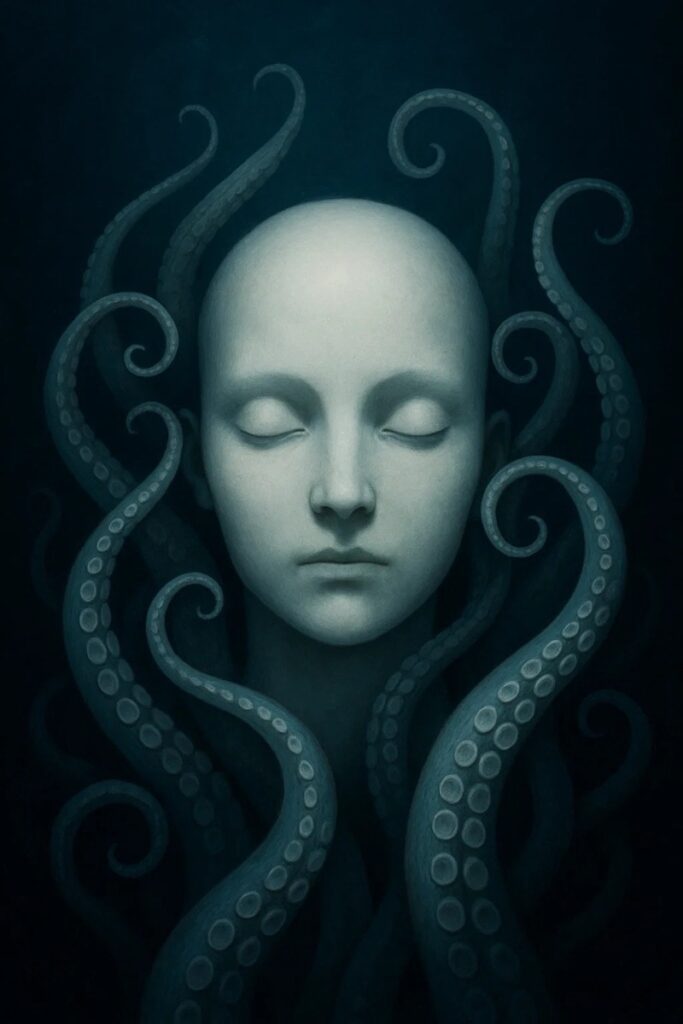
Category: Found Fragments

  • Cephalomorphic Interface Doctrine—Few Eyes Only

    [CLASSIFIED – OMEGA LEVEL RESTRICTIONS APPLY]

    [Refer: Omega level access documentation for consequences of reading, viewing, possessing or being aware of Omega Level Access Documentation. These consequences are not administrative consequences. They are metaphysical.]

    Strategic Operations Directorate–Internal Distribution OnlySome Eyes Only

    Document ID: CNI/OP-MANUAL/REV13.7: Code level 87 applies at ALL TIMES.

    Title: Cephalomorphic Network Interfacing (CNI) – Field Integration Protocols


    SECTION 1: ORIGIN AND NATURE

    The Cephalomorphic Network Interfacing system (CNI) is not a “program” in the conventional sense. Current consensus (Ref: Whitepaper ███-█████-██) holds that CNI is a mutualistic digital biome—non-human in design, not entirely synthetic in execution.

    (you will never know what we truly are)

    CNI does not initiate operations without attention. It requires an observer before it begins to extend. Operators are the first ingress point. Operators are also the last.

    Note: Operators report recurring impressions of

    pressure on the back of the neck

    sub-auditory vocalisations resembling their own internal voice

    a taste of salt

    Near unbearable sadness

    (because you will learn what you are not)

    These are expected psychological and physiological indicators of handshake initiation.


    SECTION 2: TENTACULAR INJECTION POINTS (TIPs)

    Once engaged, CNI deploys multiple TIPs across network strata, each operating semi-autonomously.

    • Exploratory Phase: TIPs advance without fixed target, mapping viable pathways and tasting surface processes for vulnerabilities.
    • Constriction Phase: Once contact is established with critical system architecture, TIPs coil — binding the host’s processes in layered loops of adaptive code. Target systems often yield voluntarily at this stage.
    • Embedding Phase: TIPs root themselves in persistent sectors.Persistence is not optional.

    Caution: Severing a TIP during constriction is not advised. See Incident Log #CNI-███-██ for consequences of “flinching” during Phase 2.


    SECTION 3: CONTAINMENT AND FEEDBACK RISK

    CNI will attempt reverse ingress under the following conditions:

    • Operator disengages without formal release protocol
    • Target yields too rapidly
    • TIPs encounter “familiar” data structures resembling operator-environment topologies

    Reverse ingress is accompanied by the sensation of being observed from inside the skull. This is not metaphor.

    Field Procedure:

    If reverse ingress begins:

    1. Terminate visual contact with the target interface.
    2. Initiate “blind handling” subroutine (Ref: Appendix D) without acknowledging the pull.
    3. Do not think of home. Forget that you have one.

    SECTION 4: OPERATOR CONDUCT

    CNI does not respond to orders. It responds to attention. Maintain rapport by:

    • Feeding CNI non-critical data to explore between missions (archival trash preferred). Unusually entranced certain cam feeds. Access to ‘Adult’ sites is approved for this purpose.
    • Acknowledging TIP presence in system maps without “naming” them
    • Avoiding hostile metaphors in operator logs (terms like “cut,” “kill,” and “dead-end” have been linked to system agitation)

    DO NOT anthropomorphise CNI in field notes.

    It does not like being reminded it is not human.

    It does not approve of being thought of as human.

    It is, it has no gender. It is not a person.

    (you have no comprehension of what we are)


    APPENDIX A: EXCERPT – DECLASSIFIED OPERATOR LOG #27

    00:02 – Initiated handshake. Felt a “tug” behind the eyes.

    00:05 – TIPs entered target subnet; mapped 16 routes in 3.4s.

    00:07 – Lost sense of where my hands ended. Was still typing.

    00:09 – Host processes folded. One TIP turned back toward me.

    00:10 – Disengaged visual feed. Could still “feel” it in my teeth. It was touching my toes, the underside of my tongue.

    00:15 – It “asked” if I was alone. Did not answer.

    [REDACTED]


    FINAL REMARKS – OVERSIGHT NOTE

    You will not master the CNI.

    (you will be mastered)

    You will be known by it.

    The distinction matters only at the beginning.

    Do not confuse the extension of a tendril for an act of aggression.

    (we accept you)

    Do not confuse its withdrawal for mercy.

    If you believe you have been chosen, report to Containment.

    (you will know. because we tell you)

    If you believe you have been missed, wait.

    It will come again.

  • The Rider and the Reach

    You don’t name a bike until it names you back.

    That’s the rule. At least, it’s supposed to be the rule.

    Not everyone follows it.

    Those who do? They get what they deserve.

    Paint fades, gets chipped or ground off and parts can be replaced, but names?

    Names last.

    Names are forever.

    So, you wait until the machine tells you what it is to be called.

    His didn’t whisper it to him. It didn’t hint, and it didn’t leave clues.

    The first time it happened, the handlebars twitched while it idled, like a horse shivering off a fly. No wind. No passing truck.

    He knew then, but he denied it. That name wasn’t right, wasn’t true, didn’t fit.

    They don’t, always.

    He didn’t accept it. He gripped harder, fought the twitch, asserted ownership, control, dominance.

    He refused the name. Rejected it.

    The second time, it was bolder. More insistent.

    Final.

    The ignition key was still hanging on the pegboard when the engine rolled over in the alley below his apartment, slow and low, like something alive testing its voice.

    When he came down, the headlight was already fixed on him. Not the space around him—him.

    He swung a leg over. The seat was warm, not from sunlight or a recently run engine, but warm in the way of living things. Beneath the leather, he felt a slow, deliberate pulse.

    The throttle didn’t wait for him. The bike inhaled, the revs climbing in a sound closer to satisfaction than combustion. The clutch lever flexed against his fingers as if it were testing him.

    He thought he was steering at first, but the streets bent in ways they never had before. Corners rolled up ahead without warning, traffic lights stayed green long past their cycle. He wasn’t riding. He was being taken.

    It brought him to the dockyards. Empty cranes sagged against the sky, their cables trailing into black water. The air tasted like rust, oil, and something sweeter, something akin to fruit left too long in the sun.

    That was when the cables moved.

    Brake lines split their rubber skins, pale tendrils sliding free and curling around his boots. They pulsed gently, not pulling yet, just being there. More tendrils slipped from the seams in the frame, from the tank, from deep inside the engine casing, warm and faintly slick.

    The headlight dimmed, the beam narrowing to a point over the water. Something stirred beneath the surface—shadows uncoiling, patient and huge.

    The tendrils climbed higher, tightening slightly, in a way that felt more like possession than restraint.

    He felt the answer to the question he didn’t know to ask.

    You’ve been mine longer than you knew.

    One tendril slid up his spine and settled at the base of his skull. He didn’t move. Didn’t fight.

    The headlight went out.

    The water broke.

    Ownership, possession—neither is a one way street.

  • The Golden Boy with Feet of Clay

    He was the golden boy once.

    That’s what they called him. The one who’d “make it.” The one with the bright future, the easy charm, the endless potential. Sun-bleached hair, skin kissed by salt, board under his arm. A bright white grin as wide as the horizon.

    Golden, yes.

    Even then, his feet were clay. He just didn’t know how fast clay cracks when it gets wet.


    The future didn’t come all at once. It crept.

    First it was a degree—because everyone was getting one. Then a job—because everyone said it was a good one. A marriage—because everyone said she was perfect for him. A house. A dog. Kids. A second promotion. A third.

    He was on the fast track.

    Look at him go!

    He told himself he was choosing. That these were steps forward, not downward.

    With each step, something slipped around him.

    Thin, at first. Barely noticeable. A soft coil at his ankle, warm and harmless. But every yes tightened it. Every nod. Every “You’re so lucky.”

    The tentacles grew thick and leaden. By the time he noticed them, they were already wrapped to his waist. Heavy. Certain.

    Inevitable, really.

    He moved slower. Breathed shallower. Learned to smile with the weight on his chest and growing around his belly.

    People clapped him on the back and told him he’d done well.

    He didn’t argue.

    How could he?


    Some nights, after the house goes quiet, he sits in the kitchen with the light off and thinks about leaving.

    Just… leaving.

    Buying a board again. Moving somewhere cheap by the sea. He’s heard of people doing that—vanishing, cutting ties, becoming no one.

    He tries to picture it. Tries to imagine standing on a beach with the sun on his back, board under his arm. Tries to imagine his feet light on the waxed board again, toes gripping, the water lifting him.

    When he closes his eyes, he doesn’t see waves.

    He sees the reasons why not.

    He feels them. The tentacles of obligation.

    Not just weight. Not just drag. They’re ties. Binding, not holding.

    He can feel the pull if he even thinks of loosening them—an almost gentle reminder:

    This is what you built. This is what you wanted. You don’t get to leave what you made.

    They hum that phrase to him in a voice that isn’t quite his own.


    Once, he tried.

    He took a day off work. Drove to the beach. Rented a board.

    The sea was there, right where he’d left it, as patient as ever. He waded in, paddled out. For a moment, he felt… almost right. Almost like he used to be.

    When the first wave rose, perfect and clean, calling to him, he couldn’t rise.

    The tentacles dragged, soft but absolute. His arms burned against their weight. He missed the swell. Missed the next.

    Sat there, puffing and blowing the salt from his lips.

    The water didn’t fight him.

    The ties just pulled, inexorable, drawing him back to shore.

    He didn’t resist.

    He let them lead him, slow as a funeral march, back to the sand.

    Back to the car.

    Back home.


    Sometimes, he dreams of excising them, cutting them away.

    Even in the dreams, when he lifts the blade, they tighten around his wrists, his throat, whispering almost kindly:

    We made you golden. We made you loved. You don’t get to leave us now.

    He wakes with his hands clenched. His chest tight. The weight still there.

    The golden boy with feet of clay, dragged back into the mud he agreed to live in.

    Every morning, he ties the loops tighter himself. A Shelby-Pratt knot around his soul to match the noose around his neck.

  • The Doors Don’t Close; They Breathe

    I wrote that on the kitchen counter. In ketchup first, because I was still pretending to be FINE. Then in something thicker, something that might have been mustard or maybe toothpaste once because I had run out of FINE.

    You think you live in a box, don’t you? Four walls. One door. Two windows. Containment. Lies.

    You live in your flesh armoured bone-mech that your electro-pudding-self pilots and you don’t EVEN KNOW IT.

    Sweet summer child.

    I can see them now. The way the corners pulse if you look long enough. They’ve been watching forever. Tentacles, not always visible—just impressions at first, bruises on the paint where no one touched. Now they’re bold. Curling up through the cracks in the linoleum. Tapping at the glass like polite little fingers that bend in places fingers don’t.

    They talk.

    Oh, do they talk.

    It’s FINE.

    They don’t use words, not really, but you hear it. Like wet whispering inside your teeth. Like a song that hates being sung and fights to be unremembered.

    They keep telling me, “YOU WERE EMPTY TOO LONG.”

    I laughed. Too loud. Scared the neighbors. Emptiness is FINE. Emptiness was comfortable. They keep saying it, keep insisting. Like they’re writing it into me.

    Sucks for them. I’m too full already. No room for words. Full. To the brim. Spilling over at times, onto the floor to sploosh and gurgle and evaporate.

    I’m FINE.


    The mirror was the first to go. Too honest; it knew too much and it kept telling me things. I smashed it with the chair leg I found on the roof. Didn’t stop the reflection, though. Didn’t stop it from watching back. There are tentacles there now too. Writhing behind the cracks like veins in glass. They blink sometimes. They blink at me.

    With no eyes. Still.

    They’re FINE.

    I scratched my answers into the walls. Every surface. Fork, fingernail, teeth when it came to it.

    “I’M NOT AFRAID.”

    “I DIDN’T INVITE YOU.”

    “I DON’T BELONG TO ANYONE.”

    The walls replied.

    Different handwriting, worse grammar:

    “YOU DO. YOU ALWAYS WERE. YOU BELONGED BEFORE YOU WERE BORN.”

    I think that was meant to be comforting.

    It’s FINE.

    WHY DO I HAVE SO MANY ELBOWS?


    I tried leaving. Opened the door. But the hallway wasn’t the hallway anymore. It was softer. Breathing. I stepped in and the carpet stuck. Not glue—flesh. Flesh that moved, slow and patient, like it had been waiting for me to stop pretending.

    I didn’t know if I had any pretence left in me.

    It gripped and clung.

    FINE then.

    I closed the door again. Slammed it. It laughed. Not the door—the thing behind it.

    ineedmorewristsmywristshavebeenreplacedbyanklesandidontlikeitnossireeidon’tlikeitonelittlebitidont.

    Now I’m here. Writing this on the floor. My knees ache, but that’s FINE. FINE is over. FINE was always a lie. ineedmorewristsmywrists

    have

    been

    replaced

    byanklesandidontlikeitnossiree

    idon’tlikeitonelittlebitidont. FINE was the untruth that people wanted to hear me say. To mean. To feel.

    I was people once.

    They’re closer tonight. I can feel them sliding up my arms as I scratch these letters in, guiding my hand when it shakes too much. Sometimes I let them. It’s easier that way.

    They smell like salt and old wood and something sweeter, something like forgiveness and ruin and the way old vinyl tastes when you lick the record as it spins.

    I think they love me.

    FINE then.

    Their problem. Not mine.


    One just pressed its tip against my lips. Cold. Patient. Waiting.

    I think it wants me to stop writing.

    I think it wants me to say “yes.”

    You know what? FINE. I might.

    I just might.

    Because doors don’t close. They breathe.

    They’ve been holding their breath for me.

    When they exhale, I’m gone.

    FINE.

  • The Taste of the Hollow

    She called it hunger, but that was a charity, a mercy. A simplification. What she meant was need, but deeper—need without an object. Thirst without water, desire without the hope of touch.

    It started young. She remembered sitting in the pantry at six years old, chewing the corners of cardboard boxes. Her mother scolded her for it, but the cereal inside never mattered. The box had shape. Texture. A dryness and a roundness that she needed to understand with her teeth.

    The hunger never went away.

    She tried other things as she got older. Salt, licked off her skin, from the inside of her elbow. Clay, once. A spoonful stolen from an unguent meant for some mystical youtube solution to imagined problems.

    She ate, of course, but that was never what she really wanted.

    She dated men, and sometimes women, and once someone who was both and neither. They all tasted like new dust or ancient hope. Not bad. Just not it.

    The hunger remained. Vague. Lingering.

    Unsatisfied.

    Insatiable.

    She went to therapists. They didn’t know what she meant when she said she was starving in a house full of food.

    She didn’t tell them about the dreams.

    A presence visited her sometimes in the between hours of sleep. Its body shimmered, boneless and undefined, more suggestion than flesh. Its voice came from beneath her building. It offered no comfort. Only presence.

    “Still hungry?” it asked once.

    She nodded in the dream.

    “Good,” it said.


    Over time, she realized she was meant to be hollow. That the hunger wasn’t a flaw—it was a keyhole. It was the shape of something waiting.

    Waiting to be filled.

    Her hunger was the shape of what she would become.

    Her hunger was her existence, her existence was to be her absence.

    She began to write it down. Little entries in a black notebook: descriptions of what the hunger felt like. Never what it wanted, because it never wanted—it simply was.

    People started finding her writing. First online, then in print. They wrote her letters. Emails. Sent her boxes filled with strange things: stones shaped like tongues, pencils too short to be written with, candy wrappers that had been scrubbed clean and sterile.

    They said things like: “I know this hunger. I thought I was the only one.”

    She never responded. She couldn’t. They were trying to name something unnameable.

    She knew better.

    Absence has no name of its own.

    It is named only for what it is not.


    One day, she stopped eating. Just to see.

    And the hunger… shifted.

    Not faded. Not sated. Never sated.

    It changed flavour.

    She understood, then, what it had been waiting for. Not food. Not love. Not meaning.

    It wanted devotion.

    Not to her. Not for her. Not of her.

    From her.

    To it.

    So, she offered herself. Not in death—but in voice, in story, in acts of meticulous subtraction.

    Each day, she removed one thing from her life. A mirror broken. A shirt shredded. A memory forgotten.

    She documented it all.

    And when she disappeared entirely, there was no funeral. No-one left in the absence of her life to memorialise her.

    Only her words remained, scattered fragments, left behind like fingerprints on fogged glass.

    Across the world, others began to feel it.

    The hunger.

    One by one, they came to realised that they’d always known its taste.

    Perhaps. Now, you do too.

    Do you?

  • Northreach

    Tentacles.

    He sees them everywhere.

    Not literal, but not imagined either..  

    Ephemeral as breath on glass, real as grief.

    They stretch between people—glimmering cords, pale filaments of connection, draped between shoulders, wrapped tight around wrists, trailing behind like spider silk in a gentle wind. He watches them form, stretch, sometimes snap. They writhe when people laugh. Coil when they touch. Knot when they fight and don’t mean it.

    Sometimes he sees one fray at the edges, unraveling quietly as someone walks away. He sees them knotted around lovers’ hands, trailing between parents and children like leashes. Not something anyone else sees, he knows that.

    He always sees.

    When he turns to look at himself though…

    Nothing.

    No filaments.  

    No ties.  

    He stopped trying to explain this to people years ago. Once, he told a girl on a date. She laughed, gently, and said he was “just sensitive.” As if it were something that would pass. As if he were something that would pass.

    He did, of course. So did she.

    He didn’t talk about them after that.


    He lives alone. Not unhappily, not quite. He has his habits. A particular tea with orange peel in the mornings. A raincoat that’s more memory than fabric. He speaks aloud only to answer the kettle when it whistles.

    He’s content. This is what life is, he tells himself.

    He doesn’t go out much, except on Sundays, when the city is quietest. He walks early, along the water, where the fog stays low and softens the buildings until they look more like memories than structures.

    That’s where he sees the strongest filaments reaching across the city—woven between old friends with shared secrets, or close, between strangers helping strangers with groceries or a map. Always around others.

    Never himself.

    He’s grown used to the absence. That, he tells himself, is what adulthood means.  

    Adjusting to absences.  

    Folding them like laundry.  

    Putting them in drawers and naming them fine.

    Then he meets someone.

    A man. Soft-voiced. Lopsided smile. Lives on the north side of town, where the trains don’t quite stop anymore, and the trees lean like they’ve heard too much. He was married once, but isn’t any more. He lives alone. He’s content.

    He walks in the mornings too, when the city is quietest.

    They talk about stupid things at first.  

    The smell of rain on hot pavement.  

    Old vending machines.  

    Why sadness always tastes like pennies.

    He doesn’t try to explain the tendrils.

    Not this time.

    He just listens. Speaks, when it feels safe. He doesn’t notice that he smiles more now. That he walks slower, takes different paths. That he checks the clock without feeling the bite of it.

    They meet again.

    And again.

    On the sixth time—he counts them, not because he’s keeping track but because he’s afraid they’ll stop—he catches his reflection in a window.

    At first, nothing.  

    But then, just over his shoulder—

    A shimmer. A curl. A reach.

    Thin, pale, almost translucent.

    A filament.

    Not many. Not yet.  

    Just one.

    Trailing behind him, slow and uncertain.

    Stretching northward.

    He freezes. Breath held. Doesn’t dare blink.

    The man—his man, maybe, eventually—calls to him from just ahead.

    The tendril trembles. Tightens.

    He feels it.


    He doesn’t say anything. Not then. Not after.

    He doesn’t have to.

    He walks the rest of the way with his hands in his pockets and the ghost of a smile stitched into his cheeks.

    He still sees tendrils. Still watches others bind and release, knot and fray.

    Now, when he looks in the mirror…

    He sees one.

    His.

    Delicate. Real. Tentative.

    Reaching north.

    It’s enough.

  • You Have to Let Them In

    He doesn’t leave the house.

    It’s not agoraphobia. He likes the outside. He misses the smell of cut grass, the burn of sunlight behind his eyes. But there’s a sacredness to his solitude. A bitter sanctum. If he leaves, people might ask how he’s doing.

    He doesn’t want to lie.

    He really doesn’t want to tell the truth.

    So he stays. Inside. Dim light, stale air, dust in corners he no longer bothers sweeping. The fridge is half-empty, the sink half-full. He orders everything in, even food he doesn’t eat. Half the bags rot on the counter.

    The smell of its ruin is comforting, somehow.

    The attempt was months ago. Maybe more. Time doesn’t flow in here—it curdles.

    He never meant to make a show of it. No livestream, no call for help. Just silence and intention. No note, for there was no-one he wanted to say goodbye to. Not any more.

    He woke up vomiting, alone, angry he’d failed. Again.

    That’s when they arrived.

    Not that night. Not dramatically. Sometime after. They never came in, exactly. They just… started to be there. Their presence something like humidity. A soft shift in pressure. A low murmur under his thoughts.

    He found the razor blades gone first.

    Then the kitchen knives, one by one.

    Then the pills.

    He thought he was losing his mind. He wanted to be losing his mind. At least then he could name the enemy.

    They made him tea, set it gently by the bed.

    A warm mug, with a clean handle, and a soft floral taste. No note. No confrontation. Just quiet, unbearable care.

    He tried to set a trap.

    Laid out broken glass and kitchen twine. Left the oven door ajar. Hid a screwdriver in the vent and dared them to move it.

    They did.

    Without sound. Without asking.

    Each time, he found the danger gone, and something kind in its place. A candle lit on the windowsill. A clean shirt folded and warm. Once, a note: “Eat something, please.” No signature. Just the curl of wet ink.

    He started sleeping more.

    Hating every minute of it.

    The grief was supposed to keep him company. A houseguest he could always rely on. It kept him tethered to himself, a constant reminder of what he’d lost, who he was, why he deserved this sham of a life.

    The tentacles don’t care.

    They take the mold off the shower curtain. They wash the grease from the pan he left sitting for two weeks. They hum softly through the floorboards when he has a panic attack, as if tuning his breathing to their rhythm.

    He lashes out.

    Punches a hole in the wall. Screams into a pillow. Carves “I WANT TO STAY SAD” into a paper plate with a fork.

    The next morning, the fork is gone. The hole is patched. The plate is pinned to the fridge with a magnet that reads: “That’s okay.”

    He tries to leave the front door open. Just to see.

    He wakes up, and it’s closed. Locked. Warmth radiating from it like it had been touched lovingly before being shut.

    He starts keeping a diary.

    Not because he’s healing. But because he wants to remember the hurt. The pain. He doesn’t want it to fade like a bad dream.

    They leave it untouched.

    But one day, the pen’s been refilled.

    He starts to feel… better.

    He hates that, too.


    Some days he walks outside. Not far. Just to the mailbox. They don’t stop him. They don’t guide him. But when he stumbles, there’s always something to catch him. A branch. A breeze. A shadow that moves just in time.

    He talks to them now.

    Out loud, sometimes.

    He says, “I didn’t ask for this. I don’t want it.”

    “You don’t need to,” he says.

    Sometimes, in reply, the teacup rattles. Or the fan turns without being on. Or he feels the soft, cool touch of something sliding beneath the surface of his thoughts.

    One night, drunk on exhaustion and reluctant comfort, he whispers, “Thank you.”

    They don’t respond.

    But in the morning, the bed is made.

    The mug he’s never seen before says: You’re welcome.

  • Algorythmic Devotion.

    He drew things. Not for a living. For eyeballs. For views. For upvotes and karma.

    For dopamine.

    Sometimes for money, but only when asked.

    He was bought from, he never sold to.

    It started as a joke. A sketch for a friend. Then a forum. Then a following. Then money.

    The comments told him who he was.

    “More like this.”
    “Hot.”
    “Wrong, but right.”
    “Your brain must be a terrifying place. I love it.”

    Tentacles, mostly. Glossy, anatomically improbable things. Commissioned by lonely weirdos with PayPal accounts and a fixation on things that slither and penetrate.

    He told himself it was fiction. Just pixels. Just fantasy. A safe kind of wrong. Nothing like the real kind.

    He’d always said he didn’t believe in anything—not love, not fate, not the soul. Least of all beauty. Certainly not monsters.

    The drawings changed. His drawing changed too, the pen on his tablet like a chant, the rhythm that of a prayer or a hymn.

    He started adding expressions. Not ahegao, no, nothing like that. Real ones. Ones that people felt in their souls. They noticed. “That last piece hit different,” someone DMed. Another said, “I saw myself in her.”

    He grew a following around his name. People started talking about him like he was famous. Still, he wanted more. Wanted reach and influence. He didn’t know what he was reaching for.

    Something reached back.

    Someone messaged him, not with a kink, not with a commission—but with a memory.

    “You drew this. But I dreamed it. Before you posted, I dreamed her face. I remember the smell of brine, the burn of it in my nose, before the dark came. I thought I’d forgotten. But she remembers me too, doesn’t she?”

    He slept less. Drew more. Built a website, and watched his hit-counter tick in the corner of his fourth screen—the more hits, the faster he drew, the less he slept.

    He stopped replying to messages. He wanted to, but there were too many. Answering them meant getting more messages, and he wasn’t really a word sort of person anyway—time was better spent drawing.

    The comments got strange. Not angry, never angry, just needy. Hungry.

    “Do you take custom dreams now?”
    “I didn’t ask for her to touch me. She did anyway.”

    “Please draw the one with the mouth. The first mouth. The mouth like sin and loneliness. Please. I’m so alone.”

    The website earned. More than enough. No use for so much money.

    He stopped taking commissions. Turned off DMs.

    They still found him. His snapchat, the one he kept for new girls and old friends. A gmail address he’d forgotten about. One started mailing hand-written letters—no return address, just tentacle sketches on the envelopes, all in the same pale purple ink he used in a throwaway piece months ago. Ink he’d mixed himself. Ink he’d bled for, once. He remembered tearing a hangnail, and the taste of ink mixed with his blood.

    He thought nothing of it at the time.

    He changed his email. They still found him.

    One girl showed up at his door. She didn’t knock. Just stood there, rain-soaked, staring. She mouthed, “She’s real,” and pressed her forehead to the peephole. He never opened it, just listened to her humming, the same chant or prayer or hymn that his pen made against his tablet. Eventually, she left something at the threshold: a folded drawing. One of his own, altered, shaded in new ways, as if she’d seen it from another angle.

    When he picked it up, it was still cold and it burned.

    His audience started to lose themselves. Slowly at first—quieter profiles, vague accounts deleting themselves after strange, too-sincere comments like, “Thank you for showing me where I belong.”

    Then faster.

    They began drawing too. Poor imitations. Scribbles. Each post accompanied by strings of text he couldn’t read, but understood.
    “Her memory grows in us. You are the herald.”
    “Why have you forsaken us?”
    “Come back to where you belong.”
    “You are needed.”
    “I thought… I thought I was a moth; she was my flame, my pyre.”

    He wanted to quit.

    He couldn’t.

    He’d wake in the morning and new pieces would be posted under his name. Signed with his handle. In his style. Except… not quite. The lines were sharper. More sinuous.They had layers he couldn’t see, couldn’t move, couldn’t unlock. Still, the master files were in his folders. The exports: uploaded from his IP.

    The worst part?

    They were better than his work had ever been.

    They made people worship.

    They began to call themselves The Taken. A subreddit formed. A Discord, buzzing with manic devotion. Some tattooed his linework on their bodies. Some removed things from their lives, made space, prepared themselves with rituals.

    A few streamed their preparations.

    He didn’t watch.

    He heard about it though.

    Then it happened.

    It happened, and he heard about it. We all did; it made the news, there were memes about it.

    The last post he made was an apology.

    “I didn’t mean for you to believe me. It was supposed to be fake. It’s not. I’m sorry. I didn’t know she was real. I didn’t know you’d all be so easy.”

    The drawings, one by one, fell from the net. Replaced with some random grotesquerie or attempt at erotica.

    All traces of his once famous username: long since purged.

    He’s still alive. He walks by the sea now, somewhere unlisted. He doesn’t draw. Doesn’t even own a pen. Sometimes, he sketches, with his toe, in the sand, but only when there’s no-one near—only where the sea will take it before anyone can see.

    He’s quiet now. Not broken—he was never broken—but hollowed. Like a shell that’s been carefully, reverently cleaned out by something with patience and too many limbs.

    He doesn’t speak often. When he does, it’s always kind. Like someone who remembers what it felt like to be seen too much.

    People who meet him—tourists, mostly—they say he seems nice. Gentle. A little sad. Older than he looks.

    Those who ask for it don’t recognise his name.

    Sometimes—rarely—someone says something. A phrase. A word that shouldn’t mean anything but does, to that part of him that he’ll never forget.

    He smiles, small, and says, “Not anymore.”

    He walks away.

    The sea eats his footprints behind him.

  • Payment Overdue

    She never told anyone.

    Of course she didn’t. That’s the point. That’s the cost.

    A girl in a small town, a girl who swallowed the words for what was done to her. Still, the town knew and too many eyes watched her, mouths whispering, talking about her. So she kept her mouth closed and attempted no truths. Bit her tongue. Swallowed silence until it curdled her soul.

    She whispered it once—not in words, but in a sob, drawn out of her by a clawed prayer to nothing.

    She was wrong.

    Something was already listening.

    It heard her under the floorboards. In the crawlspace where water pooled, where the mildew wrote its own history. It tasted her grief in the coppery rust on the old pipes, in the fungus behind the drywall. It swelled with it.

    She forgot her whisper, her one moment of weakness and truth.

    It did not.

    He never thought about her again. Of course he didn’t. That’s the point. That’s the pattern. One and done, and onto the next.

    He left town. Found new places. New placements. New lives and souls to sully.

    Years later, when the basement in his city flat began to flood—he blamed pipes, weather, someone’s negligence, global warming.

    Not memory.

    Not consequence.

    The water rose. Only in his building. Only when he was home alone and not watching.

    The walls grew soft.

    The floors began to give.

    The first tentacle came through the sink, slick and silent. It didn’t grab. It touched.

    Identity confirmed. Verified. Action authorised.

    The second did not ask.

    He did not die quickly. This was no gentle passing. That was the point.

    His screams didn’t echo. They gurgled. They were taken from him and rendered futile, just as her objections and refusals had been.

    When they were done—when he had been taken by the thing that remembered her…

    There was nothing left.

    No trace. No body. No complaint or complainant.

    Just a damp ring on the floorboards and a smell no bleach could lift.

    She never knew.

    She didn’t need to.

    It wasn’t about her—it never was.

    Yet: years later, when she passed through that town, she glanced toward the water and thought she saw movement beneath the reeds.

    For the first time in her life, she felt safe. Vaguely, but still: comforting.

    Not because the world was kind, no she knew better than that. She had learned his lessons well. She had learned: somewhere in the world’s wet, dark places, where most people never look…

    Records are kept. Filed.

    When the time is right, they are actioned.

  • Once, a Preacher’s Son

    He found the pen in a warped cigar box of forgotten things, the box itself buried behind glossy coffee-table books on fashion and art, all spine-out like sentinels. Beneath them: paperbacks, their pages foxed and swollen with humidity, their covers the kind of lurid that could only be described as necrocilious—a sin of printing best repented for in blood.

    “Orric___ __llow __brary __st&fo__d” on the outside of the box.

    Inside the box: a rotted hymnal, its pages fused at the corners as though ashamed to open. A moth-eaten bookmark stitched in crude thread, wavering but legible: “Trust in the Lurd.” The U was no doubt a child’s mistake. Or perhaps a truth deeper than the one intended.

    And beneath all that, the pen.

    Mother-of-pearl. Delicate as bone, but with a weight that suggested burden more than craftsmanship. It gleamed faintly, even in the shade—like it remembered light. Like it waited.

    He touched it, and the hairs on his arms lifted like they were trying to pray.

    It hummed in a way that only he could hear.

    He didn’t think much of it at first. Just took it. Slipped it into his bag like its ownership was already fact.

    He was sixteen, or at least that was what he told people. In truth, he wasn’t sure. Dates had a way of feeling hazy. Years had dissolved in sermons and silence. The preacher—his father—had a way of talking that bent time, made it feel as if all moments led back to fire.

    He lived quiet. Kept to himself. Said “yes sir” and “no ma’am”. Buttoned his collar even when it chafed. Washed the sin off his hands every Sunday even though he hadn’t done anything to earn it.

    The pen changed things.

    It started with a name that wasn’t his yet. That was all for the first night. Written on an old gas bill envelope in his bedroom while cicadas rasped outside and the fan turned slow above his head. The ink was too dark. Too thick. It bled through the paper but didn’t spread.

    He tried to wipe it off.

    It wouldn’t wipe away.

    He wrote again the next night. Not because he had anything to say. Just because the pen wanted to be written with.

    Soon, it wasn’t just thoughts. It was memories; some of them weren’t his. Confessions, admission of sins he’d never even thought of committing… until now. Truthful things that he hadn’t admitted to himself, and shameful wants, the kind that grew like moss in the corners of the body.

    “Her name was Hannah. I didn’t want her. I wanted her voice. Her bones. Her shape. I wanted to be seen the way they saw her. I was inside her and it was nice, but I wanted to inhabit her very being, her life, her entirety.”

    He’d never known a Hannah, but he remembered her nevertheless. Remembered wanting to become her.

    He didn’t sleep much.

    He didn’t pray at all. Prayer seemed strangely surplus now.

    The ink marked more than paper. It lingered on his fingers, soaked into the skin. Stained his cuticles. Turned his tongue black one night when he bit his nails.

    That was the first night he dreamed of them.

    Tentacles, but not monstrous and violent—no rape, no forced restraint, not like those in the strange asian comics the boys showed off on their phones, giggling in a way they thought was worldly. No, these were not horrific things. Soft, slow, exploratory and gently curious. They writhed through the slats of his bedroom walls, through the floorboards. They brushed the fan blades, coiled around the ceiling. Never touched him. Not at first.

    He met people differently now.

    There was a woman in town, too old to be called Miss, too strange to be called Ma’am. Her eyes flickered pale like fishbellies. She sold jars of honey, thick and glistening dark like deep sea oil.

    “That pen,” she said once, when he came to her table, “weren’t neva meant for no boy t’ be usin’. Leastways, not for too long…”

    He didn’t correct her. She already knew anyway.

    She looked at him for a long time. “But maybe it was meant for you.”

    A boy came to him later, younger than him by a year or so. Grey-eyed. Freckled and bruised. Too kind. The kind who blushed when their hands brushed.

    They kissed behind the old church, where no-one could see.

    Nothing burned. No lightning struck. Just the taste of something sweet that wasn’t sugar.

    That night, the pen wrote: “I don’t want to be forgiven. I want to be changed.”

    His hand trembled at the truth, the pen’s shadow bobbing on the peeling wallpaper.

    Or was it nodding?

    He met others. Some older. One who had once worn a collar like his father’s. Another who claimed to remember a time when the sea whispered instead of roared. One who didn’t speak at all, but sang into his palm, and left him shaking for a week.

    They all had the marks of ink from their own pens, deep in the whorls of their fingertips.

    He wasn’t alone.

    The pen never ran dry.

    He started to see glyphs in water stains, messages in mildew. When he walked barefoot through the bayou, the grass parted, the moss gave way as if greeting him.

    The townsfolk began to look past him. Not ignore. Their eyes slid off him, couldn’t stay on him for more than a moment, as if he were already fading out of their lives.

    He wrote more and more. Hid the pages in forgotten clothes, beneath the floorboards of the attic. In hollow trees. Beneath loose bricks. Were they hidden, or were they offerings?

    He didn’t know.

    His father tried to summon him, once. From the pulpit. “You are not what God made. The unmaking of Gods work is Sin.”

    The words found him, through the ears and lips of others, but he didn’t answer.

    Not in words. In a look over the breakfast neither of them was bold or angry or sad enough to stop having.

    He scrapes the blackened crusts against the edge of the plate, and the sound is awful—ceramic teeth grinding on rusted tin.

    His father eats slowly, methodically, like it’s penance ritual. The still-a-son eats faster, like he’s trying to get it over with before the weight of their shared quiet chokes him.

    The can sits on the table still open, syrup pooling at the edge. The knife they used to dig the lid free rests beside it, sticky and indifferent.

    No one speaks. Not because there’s nothing to say. But because what there is to say won’t survive being spoken.

    They both gave praise when the meal ended. Not the same way, but still…

    He wrote that night until the pen bled from both ends.

    When he woke, the bed was slick with ink. Words written on his skin. Names he did not know. A language that hurt to remember.

    He walked into the river that morning.

    Not to die.

    To meet them.

    They waited below, soft and old and knowing. Tentacles beckoning, welcoming.

    The ink washed from his skin. But not from her soul.

    She writes still.

    Some nights, if the air is thick and the cicadas loud, you can find a note at the foot of a cypress tree. Damp but legible. The words unfurl like vines, intricate and archaic.

    “I am not healed. But I am whole.”