• The Golden Boy with Feet of Clay

    He was the golden boy once.

    That’s what they called him. The one who’d “make it.” The one with the bright future, the easy charm, the endless potential. Sun-bleached hair, skin kissed by salt, board under his arm. A bright white grin as wide as the horizon.

    Golden, yes.

    Even then, his feet were clay. He just didn’t know how fast clay cracks when it gets wet.


    The future didn’t come all at once. It crept.

    First it was a degree—because everyone was getting one. Then a job—because everyone said it was a good one. A marriage—because everyone said she was perfect for him. A house. A dog. Kids. A second promotion. A third.

    He was on the fast track.

    Look at him go!

    He told himself he was choosing. That these were steps forward, not downward.

    With each step, something slipped around him.

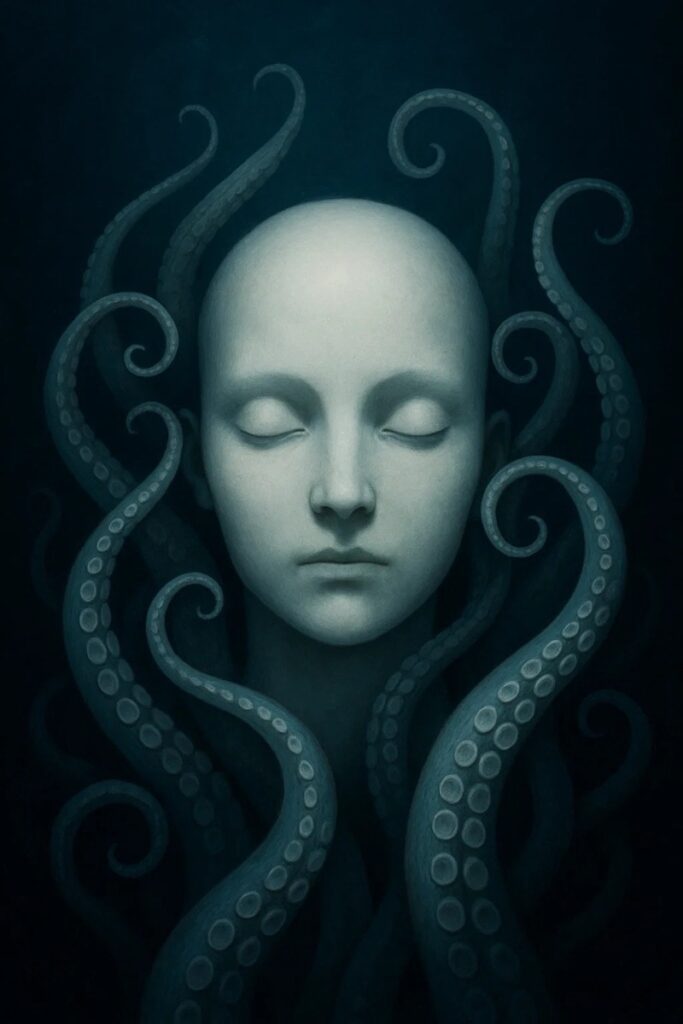
    Thin, at first. Barely noticeable. A soft coil at his ankle, warm and harmless. But every yes tightened it. Every nod. Every “You’re so lucky.”

    The tentacles grew thick and leaden. By the time he noticed them, they were already wrapped to his waist. Heavy. Certain.

    Inevitable, really.

    He moved slower. Breathed shallower. Learned to smile with the weight on his chest and growing around his belly.

    People clapped him on the back and told him he’d done well.

    He didn’t argue.

    How could he?


    Some nights, after the house goes quiet, he sits in the kitchen with the light off and thinks about leaving.

    Just… leaving.

    Buying a board again. Moving somewhere cheap by the sea. He’s heard of people doing that—vanishing, cutting ties, becoming no one.

    He tries to picture it. Tries to imagine standing on a beach with the sun on his back, board under his arm. Tries to imagine his feet light on the waxed board again, toes gripping, the water lifting him.

    When he closes his eyes, he doesn’t see waves.

    He sees the reasons why not.

    He feels them. The tentacles of obligation.

    Not just weight. Not just drag. They’re ties. Binding, not holding.

    He can feel the pull if he even thinks of loosening them—an almost gentle reminder:

    This is what you built. This is what you wanted. You don’t get to leave what you made.

    They hum that phrase to him in a voice that isn’t quite his own.


    Once, he tried.

    He took a day off work. Drove to the beach. Rented a board.

    The sea was there, right where he’d left it, as patient as ever. He waded in, paddled out. For a moment, he felt… almost right. Almost like he used to be.

    When the first wave rose, perfect and clean, calling to him, he couldn’t rise.

    The tentacles dragged, soft but absolute. His arms burned against their weight. He missed the swell. Missed the next.

    Sat there, puffing and blowing the salt from his lips.

    The water didn’t fight him.

    The ties just pulled, inexorable, drawing him back to shore.

    He didn’t resist.

    He let them lead him, slow as a funeral march, back to the sand.

    Back to the car.

    Back home.


    Sometimes, he dreams of excising them, cutting them away.

    Even in the dreams, when he lifts the blade, they tighten around his wrists, his throat, whispering almost kindly:

    We made you golden. We made you loved. You don’t get to leave us now.

    He wakes with his hands clenched. His chest tight. The weight still there.

    The golden boy with feet of clay, dragged back into the mud he agreed to live in.

    Every morning, he ties the loops tighter himself. A Shelby-Pratt knot around his soul to match the noose around his neck.

  • The Doors Don’t Close; They Breathe

    I wrote that on the kitchen counter. In ketchup first, because I was still pretending to be FINE. Then in something thicker, something that might have been mustard or maybe toothpaste once because I had run out of FINE.

    You think you live in a box, don’t you? Four walls. One door. Two windows. Containment. Lies.

    You live in your flesh armoured bone-mech that your electro-pudding-self pilots and you don’t EVEN KNOW IT.

    Sweet summer child.

    I can see them now. The way the corners pulse if you look long enough. They’ve been watching forever. Tentacles, not always visible—just impressions at first, bruises on the paint where no one touched. Now they’re bold. Curling up through the cracks in the linoleum. Tapping at the glass like polite little fingers that bend in places fingers don’t.

    They talk.

    Oh, do they talk.

    It’s FINE.

    They don’t use words, not really, but you hear it. Like wet whispering inside your teeth. Like a song that hates being sung and fights to be unremembered.

    They keep telling me, “YOU WERE EMPTY TOO LONG.”

    I laughed. Too loud. Scared the neighbors. Emptiness is FINE. Emptiness was comfortable. They keep saying it, keep insisting. Like they’re writing it into me.

    Sucks for them. I’m too full already. No room for words. Full. To the brim. Spilling over at times, onto the floor to sploosh and gurgle and evaporate.

    I’m FINE.


    The mirror was the first to go. Too honest; it knew too much and it kept telling me things. I smashed it with the chair leg I found on the roof. Didn’t stop the reflection, though. Didn’t stop it from watching back. There are tentacles there now too. Writhing behind the cracks like veins in glass. They blink sometimes. They blink at me.

    With no eyes. Still.

    They’re FINE.

    I scratched my answers into the walls. Every surface. Fork, fingernail, teeth when it came to it.

    “I’M NOT AFRAID.”

    “I DIDN’T INVITE YOU.”

    “I DON’T BELONG TO ANYONE.”

    The walls replied.

    Different handwriting, worse grammar:

    “YOU DO. YOU ALWAYS WERE. YOU BELONGED BEFORE YOU WERE BORN.”

    I think that was meant to be comforting.

    It’s FINE.

    WHY DO I HAVE SO MANY ELBOWS?


    I tried leaving. Opened the door. But the hallway wasn’t the hallway anymore. It was softer. Breathing. I stepped in and the carpet stuck. Not glue—flesh. Flesh that moved, slow and patient, like it had been waiting for me to stop pretending.

    I didn’t know if I had any pretence left in me.

    It gripped and clung.

    FINE then.

    I closed the door again. Slammed it. It laughed. Not the door—the thing behind it.

    ineedmorewristsmywristshavebeenreplacedbyanklesandidontlikeitnossireeidon’tlikeitonelittlebitidont.

    Now I’m here. Writing this on the floor. My knees ache, but that’s FINE. FINE is over. FINE was always a lie. ineedmorewristsmywrists

    have

    been

    replaced

    byanklesandidontlikeitnossiree

    idon’tlikeitonelittlebitidont. FINE was the untruth that people wanted to hear me say. To mean. To feel.

    I was people once.

    They’re closer tonight. I can feel them sliding up my arms as I scratch these letters in, guiding my hand when it shakes too much. Sometimes I let them. It’s easier that way.

    They smell like salt and old wood and something sweeter, something like forgiveness and ruin and the way old vinyl tastes when you lick the record as it spins.

    I think they love me.

    FINE then.

    Their problem. Not mine.


    One just pressed its tip against my lips. Cold. Patient. Waiting.

    I think it wants me to stop writing.

    I think it wants me to say “yes.”

    You know what? FINE. I might.

    I just might.

    Because doors don’t close. They breathe.

    They’ve been holding their breath for me.

    When they exhale, I’m gone.

    FINE.

  • The Taste of the Hollow

    She called it hunger, but that was a charity, a mercy. A simplification. What she meant was need, but deeper—need without an object. Thirst without water, desire without the hope of touch.

    It started young. She remembered sitting in the pantry at six years old, chewing the corners of cardboard boxes. Her mother scolded her for it, but the cereal inside never mattered. The box had shape. Texture. A dryness and a roundness that she needed to understand with her teeth.

    The hunger never went away.

    She tried other things as she got older. Salt, licked off her skin, from the inside of her elbow. Clay, once. A spoonful stolen from an unguent meant for some mystical youtube solution to imagined problems.

    She ate, of course, but that was never what she really wanted.

    She dated men, and sometimes women, and once someone who was both and neither. They all tasted like new dust or ancient hope. Not bad. Just not it.

    The hunger remained. Vague. Lingering.

    Unsatisfied.

    Insatiable.

    She went to therapists. They didn’t know what she meant when she said she was starving in a house full of food.

    She didn’t tell them about the dreams.

    A presence visited her sometimes in the between hours of sleep. Its body shimmered, boneless and undefined, more suggestion than flesh. Its voice came from beneath her building. It offered no comfort. Only presence.

    “Still hungry?” it asked once.

    She nodded in the dream.

    “Good,” it said.


    Over time, she realized she was meant to be hollow. That the hunger wasn’t a flaw—it was a keyhole. It was the shape of something waiting.

    Waiting to be filled.

    Her hunger was the shape of what she would become.

    Her hunger was her existence, her existence was to be her absence.

    She began to write it down. Little entries in a black notebook: descriptions of what the hunger felt like. Never what it wanted, because it never wanted—it simply was.

    People started finding her writing. First online, then in print. They wrote her letters. Emails. Sent her boxes filled with strange things: stones shaped like tongues, pencils too short to be written with, candy wrappers that had been scrubbed clean and sterile.

    They said things like: “I know this hunger. I thought I was the only one.”

    She never responded. She couldn’t. They were trying to name something unnameable.

    She knew better.

    Absence has no name of its own.

    It is named only for what it is not.


    One day, she stopped eating. Just to see.

    And the hunger… shifted.

    Not faded. Not sated. Never sated.

    It changed flavour.

    She understood, then, what it had been waiting for. Not food. Not love. Not meaning.

    It wanted devotion.

    Not to her. Not for her. Not of her.

    From her.

    To it.

    So, she offered herself. Not in death—but in voice, in story, in acts of meticulous subtraction.

    Each day, she removed one thing from her life. A mirror broken. A shirt shredded. A memory forgotten.

    She documented it all.

    And when she disappeared entirely, there was no funeral. No-one left in the absence of her life to memorialise her.

    Only her words remained, scattered fragments, left behind like fingerprints on fogged glass.

    Across the world, others began to feel it.

    The hunger.

    One by one, they came to realised that they’d always known its taste.

    Perhaps. Now, you do too.

    Do you?